Tulsa County, Oklahoma
Cherokee Industrial Resilient Power
A proposed 250 MW / 1,000 MWh battery energy storage project designed to keep power affordable and reliable.
Tap the speaker for sound
250 MW / 1,000 MWh
Battery storage capacity
$200M+ total
Estimated capital investment
$900k+/yr
Estimated local tax revenue
The project
Resilient power for a growing grid
Cherokee Industrial Resilient Power is a proposed standalone battery energy storage facility on an estimated 16-acre developed footprint in Tulsa County, Oklahoma. The facility stores electricity when it's abundant and delivers it back to the grid when demand is high — strengthening reliability and holding down power costs for the community, while bringing construction jobs and new tax revenue.
Video transcript
Full narration of the project video above.
As Tulsa County continues to grow, reliable and affordable electricity matters more than ever. Sofos Power, a utility-scale battery storage developer headquartered in Birmingham, Alabama, is developing Cherokee Industrial Resilient Power, a battery storage project designed to help keep electricity reliable for the homes and businesses of Tulsa County during periods of high demand and severe weather.
Located near existing transmission infrastructure along the Cherokee Expressway corridor, the project has been carefully sited in an area with natural screening from surrounding topography and vegetation. The system is made up of rows of enclosed battery units that can safely store excess electricity when demand is low and then return that energy to the grid when it is needed most.
There are currently over 1,000 battery storage systems operating in the U.S. alone. Unlike industrial uses, this facility does not consume any water or large amounts of electricity during operation, ensuring minimal impact to existing public resources and utilities. Instead, the project will help stabilize and support the grid by responding quickly during periods of peak demand or system stress.
Every battery unit will use newer lithium iron phosphate battery technology, the standard for safety, performance and suitability for utility infrastructure. Each unit is monitored 24 hours a day down to each cell, with automatic response systems in place to maintain safe operation. Battery units are also spaced apart to prevent and isolate potential issues, in compliance with national safety and fire protection standards, including NFPA 855 and UL-certified equipment requirements.
Coordinating directly with local fire districts, developing emergency response plans with first responders, and providing annual training is also a key aspect throughout the life of the project. The project has also been designed to minimize visibility, lighting, and operational noise for nearby residents.
Site lighting will be designed to be dark-sky compliant, and independent analysis projects operational sound levels to remain below commonly used noise benchmarks for battery storage facilities. Beyond supporting the electric grid, Cherokee Industrial Resilient Power will provide long-term economic benefits to Tulsa County through property tax revenue.
Over the life of the project, these revenues are expected to contribute approximately $18 million, supporting public services and community resources across the county. Revenue generated by the project will support schools, libraries, roads, and other public services, creating a long-term source of local funding that benefits Tulsa County communities throughout the life of the project.
Cherokee Industrial Resilient Power is designed to support the grid safely, responsibly, and with the surrounding community in mind.
250 MW
Power capacity
1,000 MWh of energy — full output for about 4 hours at a time
~16 acres
Developed footprint
A small share of the overall site, inside a secure fenced yard
LFP
Battery technology
Lithium iron phosphate batteries in third-generation containers that meet NFPA and UL safety standards
$200M+
Capital investment
Estimated total private investment in Tulsa County
$900k+
Annual tax revenue
Estimated annual property taxes to the county
$11M+
For Owasso Schools
Estimated over 20 years of operation
Up to 50
Construction jobs
At peak during the 6–9 month build
2–4
Permanent jobs
Long-term operations and maintenance roles
Siting
Choosing the right site
Finding the right site for Cherokee Industrial Resilient Power took careful evaluation: access to suitable grid equipment, land suited to this use, and enough space to house the equipment safely.
Cherokee Industrial Resilient Power is located in Tulsa County, Oklahoma.
Esri satellite imagery
Esri satellite
Grid access
The site sits close to existing grid infrastructure, supporting the interconnection study now underway.
Room for setbacks
The site design allows ample space for setbacks, buffers, and fire-code-required spacing.
Small footprint
The developed area is about 16 acres — a small share of the overall site, low to the ground and fully fenced.
Where we are
Development timeline
All dates are estimates. The schedule depends on regulatory, permitting, and interconnection processes.
Site control
SecuredLand agreements are in place.
Interconnection study
In progressGrid-connection studies with the utility are now underway.
Permitting
In progress — current stageLand use approvals and environmental permits at the local, state, and federal level.
Construction
Targeted late 2028 or 2029Approximately 6 to 9 months of construction.
Commercial operation
Targeted 2030The facility begins delivering power to the grid.
The technology
What is battery energy storage?
A battery energy storage system, or BESS, works like a large-scale version of the battery in your phone. Think of it as a savings account for electricity: power gets deposited during low-demand hours and withdrawn when the grid needs it most. Cherokee Industrial Resilient Power can discharge at full power for about four hours at a time.
Cycle
How BESS works
8%
- 1
Charge
Store when energy is abundant
During low-demand hours, the system charges from the grid, storing energy while it is cheap and plentiful.
- 2
Hold
Ready when the system tightens
Stored energy stays available under continuous monitoring, ready for peaks, weather events, or reliability needs.
- 3
Dispatch
Release when the grid needs it
At high demand, the facility discharges to homes and businesses — stabilizing the system without new peaking plants or transmission buildout.
Component by component
What a BESS is made of
These are the five pieces that matter.
- 1
Battery modules
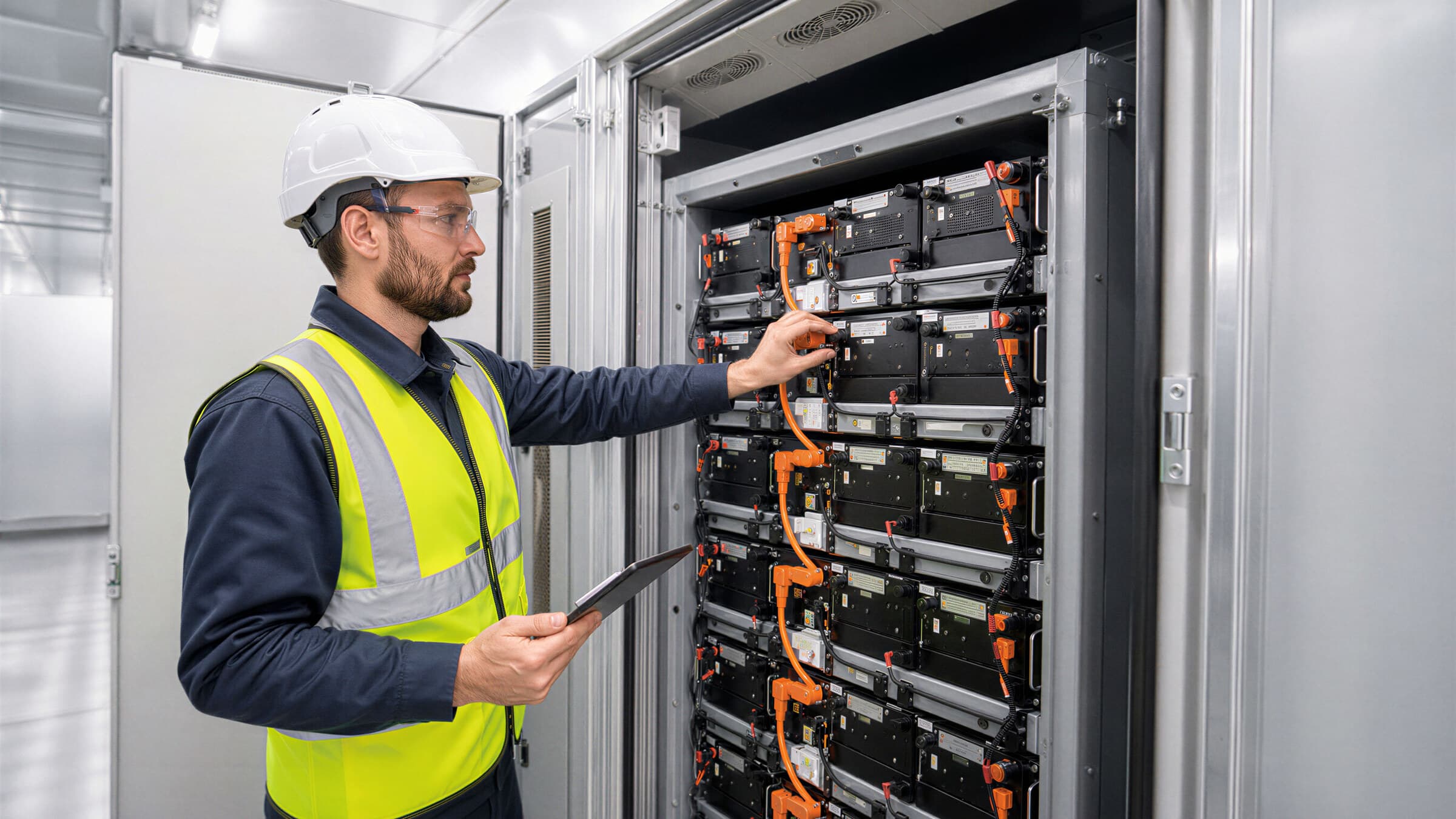
Racks of sealed lithium iron phosphate (LFP) cells, the stable third-generation chemistry, stacked inside each container.
- 2
Battery Management System
Electronics that monitor every cell 24/7 and can isolate a single module long before an issue develops.
- 3
Thermal management
Closed-loop liquid cooling keeps cells in their ideal temperature window. No water supply connection required.
- 4
Power conversion
Inverters convert the batteries' DC into grid-ready AC — and back again when the system charges.
- 5
Steel enclosure
Sealed, containerized units anchored to a concrete pad, installed in a fenced yard, and fully removable at end of life.
Component by component
What a BESS is made of
These are the five pieces that matter.
Click a number to jump to that part, or keep scrolling to step through them.
At the substation
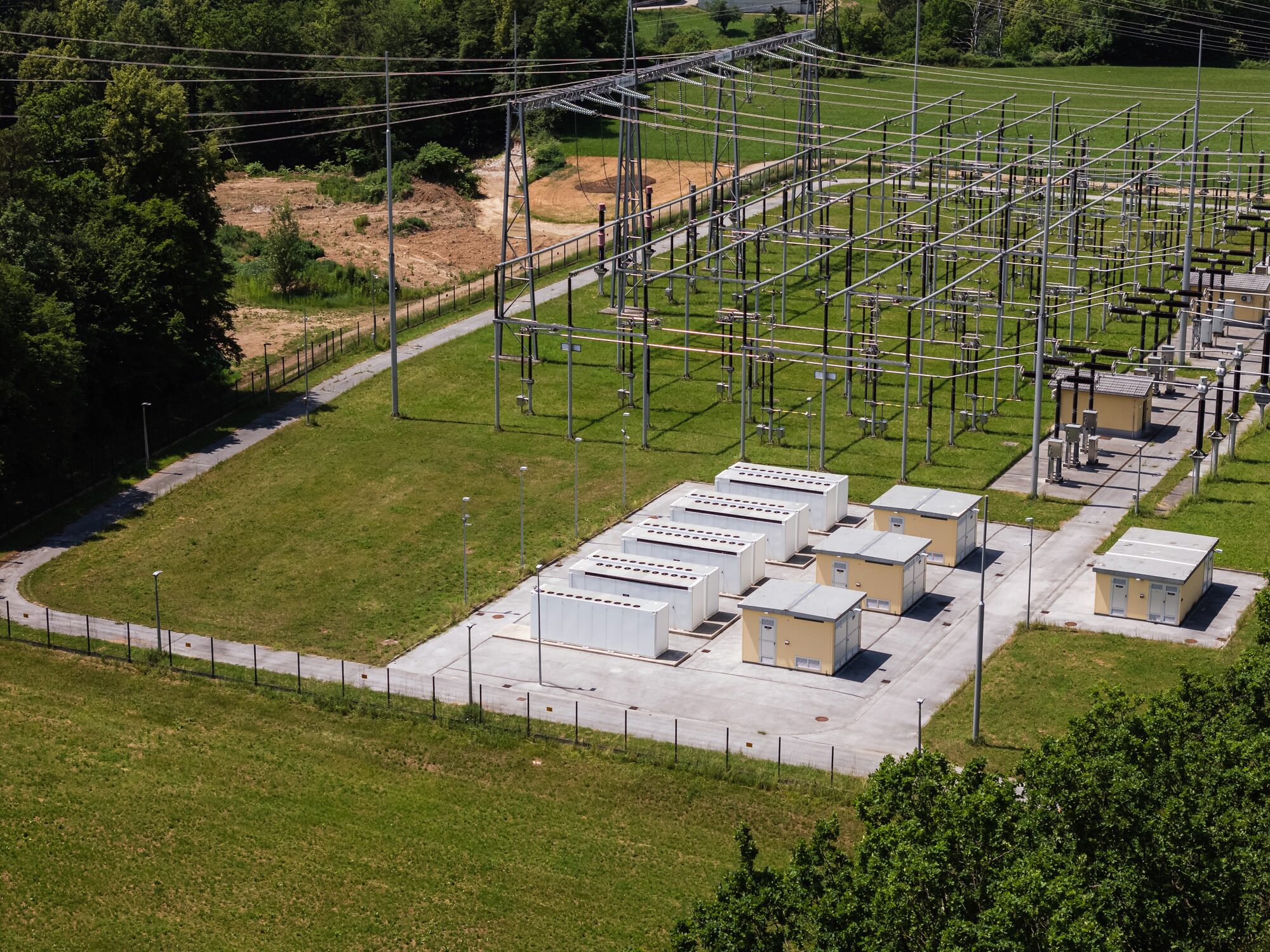
Sited next to existing wires
Utility-scale projects interconnect at the substation or transmission line — typically tens to hundreds of megawatts, with multi-hour duration. Not a power plant, not a factory: a quiet, fenced equipment yard.
Tap a + to read each callout
Why storage
Why the grid is asking for storage
U.S. electricity demand is growing while older plants retire and new infrastructure fights through multi-year queues. Storage adds dependable capacity fast — and it works regardless of how the power is generated.
Strength when the system is stressed
Batteries deliver in the exact hours the grid is tightest (summer peaks, winter cold snaps), reducing outage risk without new power plants.
Better use of existing wires
Storage makes far better use of the grid we already have, adding capacity without expanding the transmission network.
A quiet, low-impact neighbor
No smokestack, no water use for operations, minimal traffic after construction, and fence-line sound comparable to a household HVAC unit.
Community benefits
New tax revenue for cities and counties, lease income for landowners, and local jobs during construction — value that stays local.
Market trajectory
Growing industry
Storage is the fastest-growing resource on the grid — worldwide. Global utility-scale battery capacity rose more than twelvefold from 2020 to 2024, to about 124 GW, and keeps climbing as operators use batteries to manage peaks, steady the system, and defer new wires.
EMEA
120GW
APAC
400GW
AMER
150GW
Battery storage capacity by region
Cumulative GW, rounded. Through 2025 based on IEA, EIA, CNESA, and LCP Delta; 2030 outlook informed by BNEF and CNESA. Asia-Pacific is led by China (~145 GW new-type storage by end-2025).
From above
What utility-scale storage looks like
Fenced equipment yards beside existing infrastructure — compact, quiet, and low to the ground.
Operating facilities of the same type and scale — what utility-scale battery storage looks like in practice.
Our commitments
Built to be a good neighbor
Safety first
Designed, permitted, and operated to meet all applicable fire and life-safety codes and standards, including code-required spacing, detection, and suppression systems. Safety is built into every phase.
Community partnership
As the project's developer, we work in partnership with the host community — lining up project benefits that are clear, binding, and supportive of community priorities, keeping people informed through every phase, and answering questions honestly and directly.
Responsible development
The project will go through environmental and regulatory review at the local, state, and federal level, with the goal of minimizing impact on the surrounding community and land.
Answers
Frequently asked questions
About the project
What is Cherokee Industrial Resilient Power?+
What economic benefits does the project bring to the community?+
Will Sofos Power own and operate the facility?+
How does a battery energy storage system charge and discharge?+
What kind of batteries are used?+
Where does the stored electricity come from?+
How long do battery storage systems last?+
What happens to the batteries at the end of their life?+
Safety & neighbors
Is battery storage safe?+
What happens if there's a problem or malfunction?+
Could an incident affect local water resources?+
Does battery storage produce emissions or pollution?+
Does battery storage make sound?+
Contact
Have a question?
Every message is read by a person on the development team. We typically reply within two business days.
info@sofospower.com